
Walk into any toolbox and you will find wrenches of all shapes and sizes. But not all wrenches are created equal—and choosing the wrong type for a job can lead to frustration, damaged fasteners, or even dangerous situations. If you have ever stood in the hardware aisle wondering whether you need a combination set, an adjustable wrench, or a torque wrench, this guide is for you.
Understanding the differences between these three essential tools will help you build a versatile, practical toolkit that matches your needs—whether you are a professional mechanic, a weekend DIYer, or just someone who wants to hang a few shelves.
Combination wrenches are the most common type of wrench in any serious toolkit. As the name suggests, they combine two different end styles into one tool: an open end on one side and a box end on the other.
The open end fits over a fastener from the side, making it perfect for quick tightening or loosening when you have easy access. The box end, which completely encircles the fastener, provides a more secure grip and is less likely to slip, making it ideal for breaking loose stubborn bolts.
Most combination wrenches feature a 15-degree offset on the open end, allowing you to flip the wrench over to access fasteners in tight spaces without having to reposition the tool. The box end is often angled as well, giving you extra clearance over obstructions.
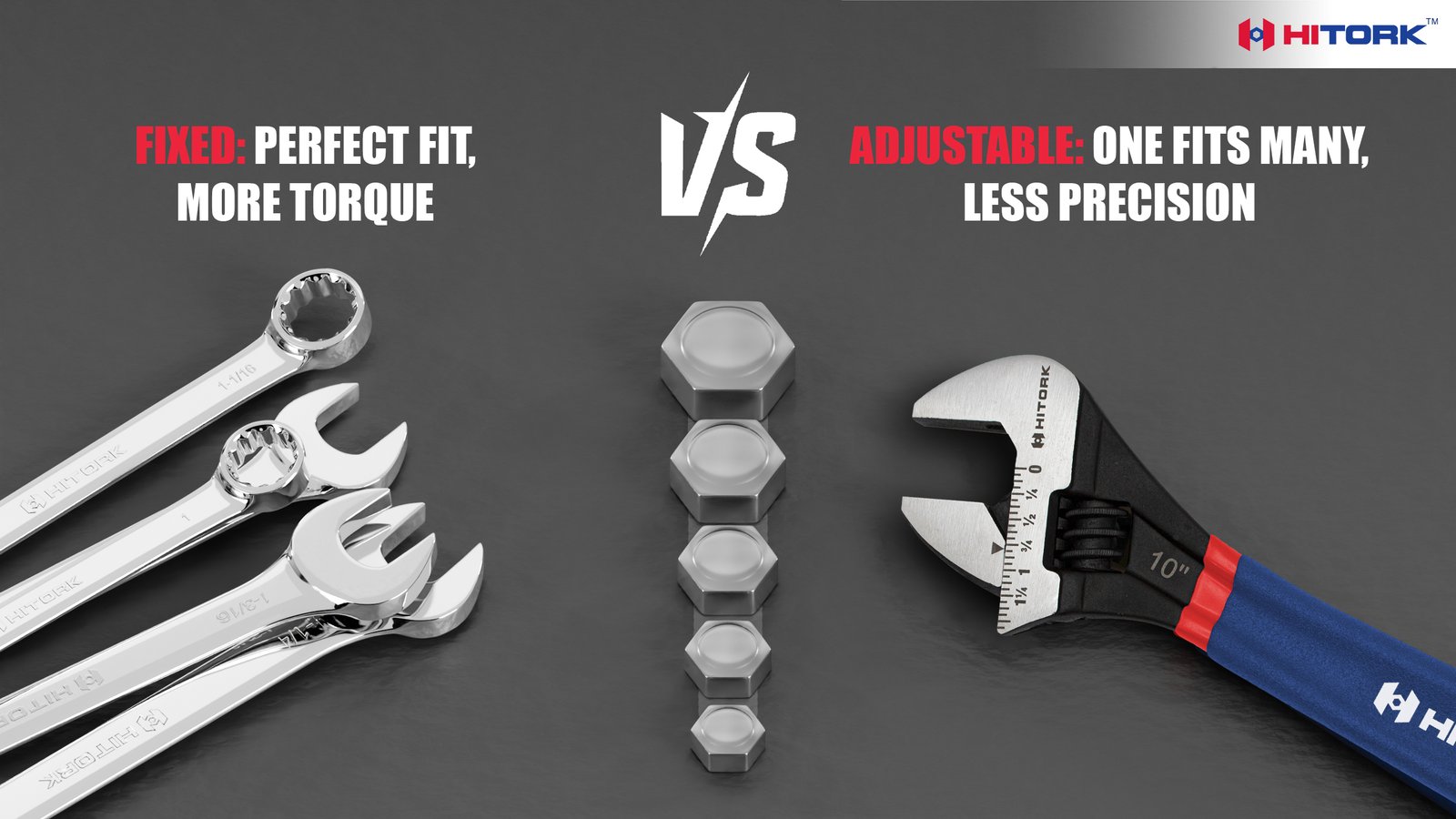
Combination wrenches are the go-to choice for general mechanical work, automotive repairs, plumbing, and assembly tasks. They provide a precise fit that minimizes the risk of rounding off bolt heads—a common problem with adjustable wrenches. Because they are fixed-size tools, they are also thinner and lighter than adjustable alternatives, allowing them to slip into narrow gaps.
The obvious downside is that you need a full set of combination wrenches to cover different fastener sizes. A basic set might include eight to fifteen wrenches, which takes up more space and costs more upfront than a single adjustable wrench. For professionals and serious DIYers, however, the precision and reliability are well worth the investment.
Combination wrenches are perfect for anyone who works on vehicles, machinery, or equipment regularly. They are also an excellent choice for building a foundational toolkit that will last a lifetime. If you value precision and hate dealing with rounded bolt heads, a quality combination wrench set is a must-have.
The adjustable wrench, often called a crescent wrench (though that is actually a brand name), is the Swiss Army knife of the wrench world. With a simple twist of the knurled thumbwheel, you can adjust the jaw opening to fit a wide range of fastener sizes.
The adjustable jaw slides along a track, allowing you to open or close the tool to match the fastener you are working on. This flexibility means you only need one wrench to handle many different sizes—a significant advantage when you are unsure what you will encounter.
Most adjustable wrenches have jaws angled at 15 degrees, similar to combination wrenches, which allows for better reach and positioning in confined spaces. They come in various sizes, typically ranging from 6 inches to 24 inches in length, with larger wrenches offering more leverage and jaw capacity.
Adjustable wrenches shine in situations where fastener sizes vary and you want to avoid carrying a heavy set of fixed wrenches. They are excellent for quick repairs, household tasks, plumbing work, and any job where you need a single tool that can handle multiple sizes. They are also useful for emergency kits and travel toolbags where space is limited.
While adjustable wrenches are convenient, they are not ideal for high-torque applications. The moving jaw can slip under heavy force, which can round off bolt heads and cause injury. They also require more space to operate than a fixed-size wrench and can be bulkier in tight spots.
A common mistake is using an adjustable wrench that is too large for the fastener. Adjusting the jaw to a wider setting than necessary reduces the contact area between the jaws and the fastener, increasing the risk of slippage. For best results, always use the smallest adjustable wrench that will fit the fastener.
Adjustable wrenches are ideal for homeowners, DIY enthusiasts, and anyone who needs a versatile tool for occasional use. They are also a great backup tool for professionals who already own combination sets but want a single, flexible option for quick jobs or unexpected fastener sizes.
Torque wrenches are specialized tools designed for one critical purpose: applying a specific, measured amount of force to a fastener. Unlike combination and adjustable wrenches, which are about turning fasteners, torque wrenches are about controlling exactly how tightly you turn them.
A torque wrench incorporates a mechanism that measures the amount of rotational force you are applying. When you reach the preset torque value, the wrench signals you—typically with a click, a beep, or a needle reading on a gauge—to stop tightening.
The three main types are click-type (most common for automotive work), beam-type (simple and reliable), and digital (most accurate, often with additional features). Torque wrenches are available with a wide range of torque capacities, from inch-pounds for delicate electronics to hundreds of foot-pounds for heavy machinery.
Torque wrenches are essential for any application where correct fastener tension is critical. This includes automotive work (especially engine assembly, wheel lug nuts, and suspension components), bicycle maintenance, machinery assembly, and any situation where overtightening could damage components or undertightening could lead to failure.
Torque wrenches are precision instruments that require careful handling. They are significantly more expensive than standard wrenches and should never be used to break fasteners loose. They must be calibrated regularly and returned to their lowest setting after each use to maintain accuracy.
If you work on vehicles, assemble engines, or perform any task where proper torque is critical, a torque wrench is non-negotiable. Even occasional DIYers should consider one for tasks like changing tires or installing spark plugs. For those with a 3/8-inch drive set, a torque wrench covering a range of 10 to 100 foot-pounds will cover the majority of automotive applications.
| Feature | Combination Wrench | Adjustable Wrench | Torque Wrench |
|---|---|---|---|
| Primary Purpose | General fastening | Versatile, multi-size fastening | Precise torque application |
| Precision | High (exact fit for one size) | Low (risk of rounding bolts) | Very high (measured torque) |
| Versatility | Low (requires full set) | High (one wrench fits many sizes) | Low (specific torque ranges) |
| Common Use | Mechanical, automotive, assembly | Quick repairs, plumbing, household | Engine work, wheel nuts, critical fasteners |
| Pros | Secure grip, slim profile, durable | One tool for many jobs, space-saving | Ensures proper tightness, prevents damage |
| Cons | Needs full set, limited to one size | Can slip, less torque capacity | Expensive, needs calibration |
| Skill Level | All levels | All levels | Intermediate to professional |
If you are starting from scratch, here is a practical approach to building your wrench collection.
Start with a Combination Set: A good-quality combination wrench set in metric or SAE (or both) is the foundation of any serious toolkit. Look for a set that covers the sizes you encounter most often—typically 8mm to 19mm for metric or 1/4 inch to 3/4 inch for standard. Chrome vanadium steel construction and a polished finish are signs of quality.
Add an Adjustable Wrench for Flexibility: Even with a full combination set, a quality adjustable wrench is a worthwhile addition. It will handle odd-sized fasteners, serve as a backup, and reduce the need to carry your entire set for small jobs.
Invest in a Torque Wrench for Critical Work: Once you start tackling more complex projects, a torque wrench becomes essential. For automotive work, a 1/2-inch drive click-type torque wrench covering 20 to 150 foot-pounds is a great starting point.
Regardless of which type you choose, quality is paramount. Cheap wrenches are made from inferior steel that can bend, break, or round off fasteners. They also have looser tolerances, which means they do not fit fasteners as precisely as better-made tools.
When shopping for wrenches, look for reputable brands that use chrome vanadium or chrome molybdenum steel. Drop-forged construction and a good finish (such as full polish or satin chrome) are indicators of quality. A tool that feels solid in your hand and fits fasteners snugly will serve you for decades.
Choosing the right wrench set comes down to understanding your needs and the type of work you do.
Combination wrenches are the backbone of any serious toolkit. They provide the precision, strength, and reliability needed for most mechanical work. If you are building a toolkit for vehicle maintenance, machinery repair, or serious DIY, this is where your investment should go first.
Adjustable wrenches offer unmatched versatility for quick jobs, household tasks, and situations where fastener sizes are unpredictable. They are a valuable addition to any toolkit, especially for beginners or as a convenient backup.
Torque wrenches are the key to precision and safety in critical applications. They are indispensable for automotive work, equipment assembly, and any task where proper torque matters.
In truth, most people benefit from having all three. A combination set handles the bulk of your work, an adjustable wrench provides flexibility, and a torque wrench ensures you can do precision work safely. With the right tools in your box, you will be ready for virtually any fastening challenge that comes your way.